Tuesday, October 12, 2010

Rock and Roll Fantasy


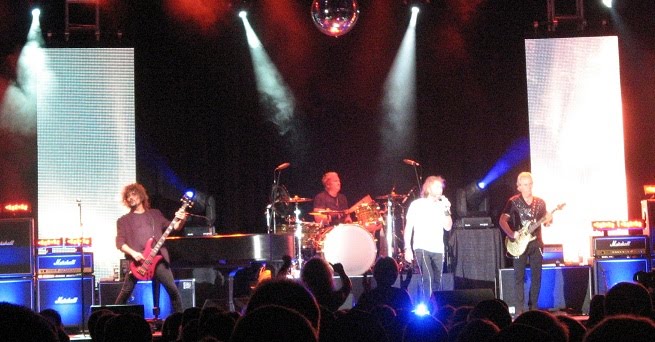
Paul Rodgers, October 9, Shelton, WA

No wonder he's called “The Voice.” At 60, Paul Rodgers shows no signs that his haunting, powerful voice is in any way diminished.

Interesting that he started out as a bass player (wouldn’t you know it). With that sensitivity, he co-wrote All Right Now with Free bassist Andy Fraser in 1970. Twenty years later ASCAP recognized it for receiving over one million radio plays in the U.S. alone.

Mr. Rodgers has a powerful stage presence, and unlike some of the performers I’ve seen recently, he really connected with the audience. He talked to us (in his deep British accent), responded to us, and invited us all to come up front to the stage. It was a great experience being right up in the first two rows within reach of the band. Shooting Star was wonderful, as was Rock and Roll Fantasy. I loved hearing some of the more obscure stuff from one of his early bands, The Firm, like Satisfaction Guaranteed.

Paul has ties to many of our Seattle musicians. One of my favorite local bassists, Lynn Sorenson, again demonstrated his rock star playing prowess as well as his formidable charisma. And it was great fun seeing Jeff Kathan, who just a week ago had played at Salmon Days, pounding the drums on stage with these other superstars.

[A brief mention here about a phenomenon happening in Washington State: the Casinos. Because of Native American rights, there is now a proliferation of huge, new—and beautiful—casino/hotels popping up all over the state. Little Creek Casino in Shelton, about an hour from Seattle, is a great example. It's a strange thing, like stepping back in time, when smoking and drinking was allowed (if not encouraged) everywhere. But, lucky for us, there is a whole new circuit where our favorite rock musicians can gig.]

It was a fantastic night. To top it all off, Paul Rodgers is a nice guy. As he wished us good night, he said, “Take care, and be kind to each other.”

Saturday, October 9, 2010

The Social Network


The Social Network, The Movie

Go see this movie. Forget the hype, just go. Forget that there are no “stars” in the film, that there is no typical Hollywood action. That’s a good thing. This movie rocks.

Even if you’re tired of hearing about Twitter and Facebook, and you generally steer clear of privacy-compromising internet inventions or ideas, you’ll want to have seen this movie. From the first few moments, as the story opens in a dorm room at Harvard in 2004, you will be gripped by the story. The story of a 20-year-old kid who had an "online sharing" idea that within 6 years over 500 MILLION people use around the globe.

Mark Zuckerberg is simultaneously our hero and our antagonist. If the character in the film even somewhat faithfully portrays the real man, this guy is much more than smart and interesting. He is downright scary how brilliant and quick his mind is. The screenwriter, Aaron Sorkin, of West Wing and A Few Good Men fame, does a fantastic job of keeping the dialogue crackling and sharp, and I had to laugh out loud as Zuckerberg surgically taunts the attorneys in the arbitration scene.

The film is witty and sharp throughout, from the dialogue to the camera direction, to the sets, to the editing. The director, David Fincher, shows us his prowess as director of stylish thrillers, translated into an even more mesmerizing reality. And, as important, you will learn a lot about what is going on in our world right now, that is changing everything, forever.

Read the review.

Monday, October 4, 2010

Salmon Dayze


Salmon Days 2010, Issaquah, Washington, October 2-3

I thought I knew what I was getting into: lots of crowds, typical fair booths, patchouli soap and garden art. Corndogs.

What I didn’t expect was a rocking show complete with famous guitar players, drummers, and Go-Go dancers. But I should have known: Magic Bus was playing. And, thanks to the music organizer of Salmon Days for the past 27 years, we enjoyed stellar musicians, mega-wattage and great sound. I missed seeing Lynn Sorenson, who is currently touring with Paul Rodgers in Hawaii, but Jeff Kathan lit up the traps with his fierce, masterful drumming. I particularly enjoyed Terry James Young, from the Seattle band Rail, on lead vocals and bass. Lloyd DeBar played a brilliant lead guitar. Steve Hanna on guitar and keys rounded out the sound. It’s not every day you hear Rick Derringer and Led Zeppelin tunes played live and loud. The fabulous cage dancers Dannielle and Shannon added that sexy Bond Girls vibe.

And we had to see the Salmon. Their triumphant, bittersweet return home, all the way upstream from the Ocean. You see scores of these big, heavy fish, each about 4 feet long, chopping their way up the shallow river bed, and you hope they succeeded in their life-long quest to return home to spawn. That’s the interesting thing about Salmon Days; it subtly highlights a cosmic sense of connection to each other and to Earth. How can we tread lightly on our environment and the other living things that were here before us?

Saturday, October 2, 2010

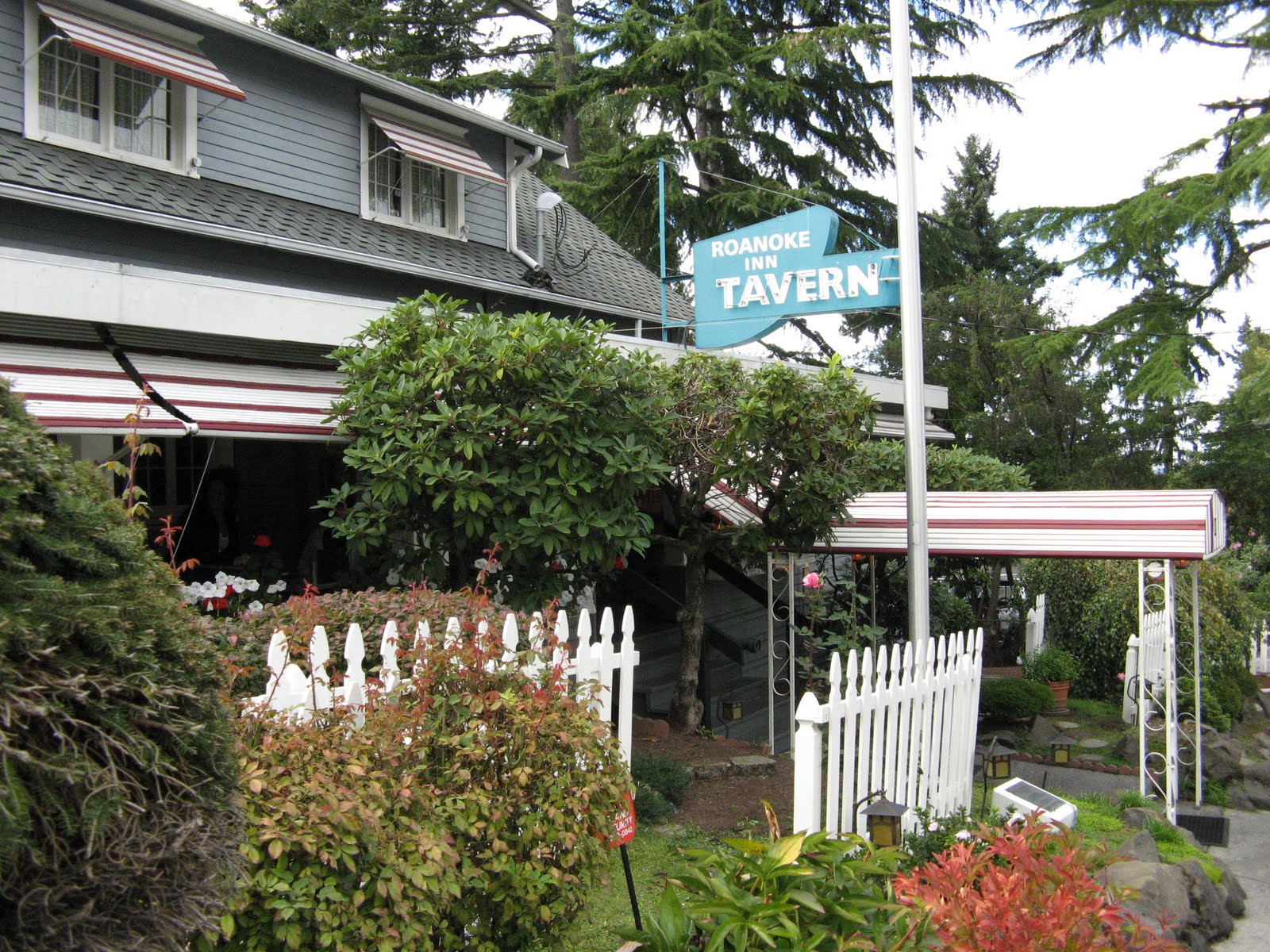
Roanoke Inn on Mercer Island


Sometimes the place is hopping until 2 a.m. With lots of comings and goings, a jukebox blasting anything from Rooster to Radar Love, and a demolition derby gravel parking lot, it’s not exactly quiet. But the last time one of the neighbors tried to have it shut down, they didn’t realize the Mercer Island City Council meets there every Tuesday night. The Roanoke is a regular institution. And of course it’s haunted: urban legend is that it used to be a brothel and weekend gambling escape during Prohibition.

The Roanoke was built in 1914 in the craftsman style, with large wrap-around veranda and patios side and back. It sits near the point where ferry traffic from across the lake used to land, bringing business men home from downtown Seattle.

When Island roads improved enough, more tourists went exploring. To appeal to the visitors as well as to serve the community, George McGuire built a chicken-dinner inn not far from the ferry dock. At first business was not exactly brisk, and McGuire lost the inn because of debts. A Mr. Green took over and operated it as a hotel.

Subsequently it was sold several times, sometimes falling into ill repute, rumored to be a brothel and a purveyor of illegal booze served in coffee mugs during prohibition. Then for decades they just served beer and wine, and a small menu of burgers and burritos. With an expanded kitchen and a liquor license, the ‘Noke has waltzed into the new century. It stands today, well preserved and looking much the same as it did almost a hundred years ago.

I like it for the casual old-Seattle feeling and the interesting crowd. With its dark green walls and fascinating collection of memorabilia, it has an old-world Pub character. I’ve seen everyone from famous Seattle business men to socialites, from rock stars to sports stars. If you go on a Friday afternoon, I suggest getting there by 4pm to score a booth.

Sunday, September 26, 2010

Railroad Earth

Todd Sheaffer, Lead Vocals, Accoustic Guitars

Andrew Altman, Bass; Tim Carbone, Violin and Vocals

Carey Harmon, Drums and Vocals

John Skehan, Mandolin and Vocals

Plugged In


Railroad…station. Terrapin…Station? Earth = Terrapin? Railroad Earth.

Terrapin - I can't figure out
Terrapin - if it's an end or the beginning
Terrapin - but the train's got its brakes on
and the whistle is screaming: TERRAPIN

--from Terrapin Station, Grateful Dead

Seems to me the roots of Railroad Earth are closely aligned with Grateful Dead bluegrass roots, and it was fun to see a band that got everybody dancing.

I hear people complain all the time, “Young people listen to such garbage!” or “No one under 30 has good taste in music!” and I beg to differ. Youth may not be completely wasted on the young! There is a movement where 20-somethings actually care a LOT about great writing, musicianship, and melody. I witnessed this first-hand at the Showbox in Seattle, with Railroad Earth. Next to me was a 20-year old fan from Minnesota who had traveled to Seattle to hear her favorite band, singing along, knowing all the words.

There is definitely a following of loyal young fans. RR Earth does a good job communicating with their 25,000+ fans via Facebook. Touring professionals, the band members had all first mastered their acoustic instruments before going electric (“Bob Dylan, how could you?!”) And you can see an almost reluctant plugging-in of hollow-body guitars. I especially enjoyed the electric hollow-body bass (not a Hoffner, but sweet) and banjo. Nice mandolin playing, great classical guitar picking, the treat of an acoustic bass, and a monster violinist, all melded to make memorable, danceable music. The crowd got the old wooden trampoline-of-a-dance-floor bouncing pretty good!

One of the challenges for this band is properly mic’ing the lead singer; if it weren’t so hard to distinguish the words we might have had the benefit of experiencing the lyrics along with the music, and it would certainly have been more meaningful. From YouTube I know they do some good writing. A few more years on the road, perfecting their sound, honing their writing, and you never know…

Friday, September 24, 2010

Mythical Northwest Coast

Andy Warhol's Northwest Coast Mask 1986, based on a mask in the Smithsonian

First Nations art-influenced logo

Thunderbird Totem Pole, Museum of Anthropology, U. of BC

Bill Reid's Raven and First Men 1994, carved from a single 8' wide piece of yellow cedar

Tony Hunt's Raven and Moon

Flavoring Seattle is the subtle but omnipresent influence of the First Nations, or Northwest Coastal Indians; their art, traditions, and history. It is all around us, from the Seattle Seahawks logo to restaurant signs; you’re surprised by the occasional totem pole in a park, and the smell of roasting salmon in cool fall air. This influence gives Seattle a certain mythical power.

A hundred-fifty years ago, the Puget Sound’s waterways were the highways, and inland was locked by giant fir trees growing so close together you couldn’t walk between them. You can glimpse the Puget Sound of a long time ago by reading The Curve of Time by M. Wylie Blanchet.

Or, set foot in the Museum of Anthropology at the University of British Columbia in Victoria, B.C., and your skin tingles. Feel the First Nations’ people’s relationship with the universe, their tuned-in view of man in relation to nature. Everyday objects as well as ceremonial treasures honor this sense of (what Jerry Garcia called “The Group Mind”) oneness, in the way they are carved, the mythical creatures they honor, and the connection to the sea and stars.

Bill Reid (1920 – 1998) is probably the most recognizable name in the astounding pool of northwest coastal artists. He’s world famous for carving “Raven and First Men” from one gigantic piece of yellow “nootka” cedar, depicting the Haida creation story, where Raven opens an oyster shell on the beach to find the first Humans.

Tony Hunt is also a world-famous carver and print artist. He was born in 1942 at the Kwakwaka'wakw community of Alert Bay, British Columbia. His brothers, Stanley Hunt and Richard Hunt, are also professional carvers. You can still find their original mask carvings at auctions here and there.

Many northwest homes feature masks, carvings, prints, and totem poles from these and other artists. I think the Seattle Art Museum has the second finest collection of ceremonial masks in the world (second only to the U of BC museum) and it’s a good place to get educated on the subject.

When you’re ready to buy, visit my favorite gallery in the world for collectible First Nations art: Alcheringa Gallery in Victoria, B.C. Or, try going to the source: Duncan, British Columbia. Duncan is the Totem Pole Headquarters of the world, and many carvers sell directly to buyers there. Schedule your own trip on British Columbia Ferries.

Sunday, September 19, 2010

FURTHUR, THE EXPERIENCE

Furthur's set list, from their Facebook page

Photos by Irene Graham


Legendary Grateful Dead Band plays Remond, Wa
Third of Three Installments

Furthur at Marymoor Park, September 18, 6 p.m.
See the previous two installments:
Furthur, The Music
Furthur, The Band

FURTHUR, THE EXPERIENCE
Cosmically, the rain starts just as we walk through tall trees up to the main gate. As we’re getting our bags checked we rummage for rain ponchos. After that we hardly notice the rain—the focus is all on getting to the stage.

It’s definitely a different experience being up close (4th row center). The supreme professionalism of the stage setup, the caliber and complexity of the sound equipment and the magnificent instruments, is all laid out like a gorgeous banquet. It occurrs to me that Bobby has been touring for 45 years, pretty much non-stop. These guys are all at the very top of their game.

The plastic-sheeted fans are pumped up, ready to party. The band comes out to cheers from new and long-time fans. Familiar faces in the crowd smile knowingly, “Gonna be a party tonight, uh-huh!” as they roll into the first number, Mississippi Half-Step:

Half-step
Mississippi Uptown Toodleloo
Hello baby, I'm gone, goodbye
Half a cup of rock and rye
Farewell to you old southern sky
I'm on my way - on my way


The next song, Stagger Lee, is particularly amazing. I haven’t heard it live in concert for several years, and JohnK does a nice job on the guitar and vocals. I’m haunted by echoes of Miles Davis in the jam…those high held notes... The next few songs roll along in perfect contentment, the fans dancing, singing along, Phil smiling and grooving with Bobby, all having a real good time.

Jerry Garcia is always so palpably missing. His soulfulness came out at the most unexpected moments, through a cracking voice, or that perfect high note on the guitar. It’s hard. But JohnK holds it down. It isn’t until the last song of the first set, Sugaree, that I almost cry...

Just one thing I ask of you
Just one thing for me
Please forget you knew my name
My darlin’ Sugaree


Intermission is almost an emotional relief. I’ve never attended a concert with a friendlier, kinder, happier crowd than at a Dead concert. Tonight is no different. We’re all in it together, the rain, tarps, wet chairs. None of it matters. Just the music.

The band continues to pull at our heart strings as they open the second set with Steve Winwood's classic Dear Mr. Fantasy and then stride right into one of my favorite Bobby songs, Cassidy. It showcases Bobby’s special songwriting skills: his unusual and original chord changes and vocal modalities that I’m only recently coming to fully appreciate. The show is complete for me when they swing into The Wheel and I poignantly remember the Ventura, CA show in 1985, sunset, ocean waves crashing in the background, crowd bouncing on the old wooden bleachers. For me, the concert is an accumulation of special moments, relived across the decades. Some of the best moments in my life.

A lull and maybe still missing Jerry, it feels like Fire on the Mountain is a bit lackluster, and it isn’t until I Know You Rider that the energy is back up to megawattage. They’ve been doing Going Down the Road at a lot of their shows lately, so that is no surprise, but it’s always endearing and fun when they throw in an old cowboy song like that. Next, we all come full circle when they sing Bid You Goodnight, as Dark Star Orchestra performed a superb heartfelt rendition of it on their spring tour.

And, being Saturday, Bobby had to make the set list change at the last minute (I know it was you, Bobby!) and do one of his favorites, because he gets to whale on the rhythm guitar—it’s one of the best whaling strumming songs out there, One More Saturday Night. I know I’m extremely grateful to have had one more Saturday night with this band, and it was clear they felt the same way about us.

Tuesday, September 14, 2010

FURTHUR, THE BAND

Furthur, Today

Jerry Garcia, Bob Weir, and Phil Lesh in 1974

Phil Lesh-Grateful Dead, Berkeley Greek Theater, San Francisco 1981,
Photo by Irene Graham (I was there!)

Bob Weir, Greek Theater, 1981 ("Bobbyyyy!!!")

John Kadlecik of Furthur, 2010


Legendary Grateful Dead Band FURTHER plays Redmond, WA
Second of Three Installments; see installment #1: Furthur, The Music

Furthur at Marymoor Park, September 18, 6 p.m.

FURTHUR, THE BAND
Grateful Dead founders Bob Weir (rhythm guitar and vocals) and Phil Lesh (lead guitar in the lower register, or bass), are joined by John Kadlecik (little Jerry lead guitar) of Dark Star Orchestra, along with Jeff Chimenti on keyboards (from Bob Weir’s band Ratdog) and Joe Russo on drums (collaborations with Phil Lesh & Friends, and Phish).

The thing about Bob Weir that I’ve only recently begun to fathom, is just how great a rhythm guitar player he really is. Subtle and masterful, he consistently weaves a rich texture in and around the performance, artfully guiding the orchestration while empowering the vocals and other guitars. Listen for his influence in “Help on the Way” and “Let it Grow.” He’s also become a fine singer, although personally, I miss the cute “Bobby” of the early concerts, and wish he’d lose the ZZ Top beard! Bobby was adopted, and in this truly amazing autobiographical article, shares his story about the life-long odyssey of finding his family, and the magic telecaster that finally made The Big Time.

The English language is just plain inadequate for describing the bass playing artistry of Phil Lesh. He sees no reason why a bass guitar can’t be played with as much creativity and soulfulness as a lead guitar, rather than focusing on the downbeat. He rocks my soul. My bass instructor Danny Morris, a huge Phil fan, at Berklee College of Music said, "Wouldn't it be great to tour the world as a jazz improvisation band, disguised as a rock band?" Phil turned 70 on March 15 this year. One of his more personal causes is organ donorship: he successfully survived a liver transplant over 12 years ago. When I think of the many, many fabulous musical moments he has given me, I want to give him a liver, and a kidney, too!

A quick Time Out here to tout two other important causes formed and supported by the Grateful Dead family:
Furthur Foundation: For nearly 25 years, the Furthur Foundation has been giving money to progressive non-profit groups working on environmental and social change issues.
Unbroken Chain Foundation: Created in the spring of 1997 by Phil Lesh and friends, the Unbroken Chain Foundation is a nonprofit organization which seeks to perpetuate the long-standing tradition of community service that has been the hallmark of the remarkable three-decade relationship between the Grateful Dead and its audience.

After Jerry Garcia’s passing in 1995, the Grateful Dead went through a few iterations, as The Other Ones, and recently The Dead (The Gorge, May 16 2009), which featured Warren Haynes (Allman Brothers Band) on lead guitar (in the Jerry position). Warren was bluesy and slidy, which was fun and a little country, but I think this is going to be my favorite lineup since Jerry: John Kadlecik on lead. He brings 12 solid years of touring and playing Grateful Dead material with Dark Star Orchestra, a high-powered, professional tour de force. John says, endearingly, “I listened to classical music and my old, hand-me-down Beatles albums, and that’s pretty much all I listened to until high school in ’83-’84. At that time I had some friends who turned me on to The Police and The Cars and Rush and Led Zeppelin and Pink Floyd—which a lot of people considered to be passé and oldies by that point, I suppose, but I didn’t care.” (Neither do I!!) Through a friend John discovered Grateful Dead music in 1987, and 23 years later he is playing lead guitar with the legends he worshiped!!! Read the entertaining John Kadlecik Interview.

Jeff Chimenti rocks the keyboards. From the further.net site: “Although he had never listened to Grateful Dead music, his relationship with saxophonist Dave Ellis introduced him to Bob Weir, and in 1997 he replaced the legendary Johnnie Johnson (of Chuck Berry fame) in Bob's band "RatDog." He later was the keyboard player for the Dead's re-constituted band "The Other Ones" which officially became "The Dead" with stints in 2002-2004, and then again in 2009.

Joe Russo on drums: Growing up in Northern NJ with walls covered by KISS posters, compelled by fire, make-up, and the ways of rock, Joe Russo began playing drums at the age of 8. Cutting his chops in the shadows of Bonham, his early tendencies leaned strongly to hard rock. At the age of 13, through the guidance of his teacher Frank Marino (Long Island Drum Center of Nyack) Joe began to discover a whole new world of drumming.

Stay tuned for the next installment: Furthur, The Experience

Monday, September 13, 2010

Legendary Grateful Dead Band FURTHUR Plays Redmond, WA


First of three installments
In an attempt to give you context for this amazing event, I’ll be covering three areas over the next few days: The Music; The Band; The Experience

Furthur at Marymoor Park, September 18, 6 p.m.

FURTHUR, THE MUSIC
Furthur is the next evolution of the Grateful Dead, who toured 1965 – 1995—thirty years. To be able to hear this music again, live, with the original bass and rhythm guitar players…!

If you’re a Deadhead, you’re intimately familiar with the grandeur of the lyrics written by Robert Hunter, the foremost poet-collaborator in the GD world. You can thank him for scribing masterpieces like Ripple, St. Stephen, Wharf Rat, Dark Star, and hundreds of others. Hundreds. The sheer magnitude of his contribution is staggering. What may not be commonly known is that Bob Weir also wrote a significant number of well-known songs, the best of which were co-penned by Hunter (Sugar Magnolia) and John Perry Barlow (Cassidy, Looks Like Rain, and Let It Grow).

Deep in our lexicon we’re haunted by lines like “must’ve been the roses” and “let there be songs to fill the air…” Jerry Garcia and Bob Weir put the words in a magic music cauldron and out wafted some of the finest, most soulful musicianship and improvisation in history.

The Annotated Grateful Dead Lyrics site based at UC Santa Cruz, provides an accurate historical archive of GD’s original song lyrics. You may also have seen my piece about archive.org where you can get high quality live concert recordings for free (last I counted, the Grateful Dead had 7,300 concerts listed there!) In the past few weeks of the Furthur tour, they’ve been including these classics in their set lists, so if you’re going to the show, get ready for some amazing live music moments:
Cassidy
Loser
The Other One
Terrapin Station
Unbroken Chain
Help on the Way/Slipknot
Wharf Rat


It's a miracle that you can still get tickets to the show. You can also purchase live concert recordings from the Furthur tour via digital download. Or order the live shows on CD.

Here's an excerpt from the song “Broke-down Palace”:
River gonna take me
Sing me sweet and sleepy
all the way back home
It's a far gone lullaby
sung many years ago
Mama, Mama, many worlds I've come
since I first left home
Goin home, goin home
by the waterside I will rest my bones
Listen to the river sing sweet songs
to rock my soul

Stay tuned for the next installment: FURTHUR, THE BAND

Saturday, September 11, 2010

Mid-Century Modern Utopia


When we think of mid-century modern, we picture the swooping glass and concrete gems in Palm Springs and Southern California designed by architects like Richard Neutra, Rudolph Schindler, and Joseph Eichler. Who knew there was a mid-century modern enclave right here in our own backyard?

This weekend I toured the Hilltop community in Bellevue, Washington. Hilltop, with its 39 homes and common spaces, collectively shines as an example of paradise kept.

The founding members, mostly artists, architects, builders, engineers, and University of Washington faculty, pioneered the cooperative community in 1948 to value modern architecture, natural beauty and democracy. The band of families united to design and build their dream neighborhood, pooling $15,000 to buy a 63-acre site in what was once a logged-off, brambled area with limited access at an elevation of about 1,000 feet. They mapped 40 one-acre lots surrounded by a greenbelt to preserve views, greenery and privacy. They built and maintain roughly 13 acres of common land, including nature trails, a swimming pool, a tennis court, picnic tables and a playground.

“The architecture here, it doesn’t impose itself on the land,” said a current owner. “The houses are often tucked in, but light, bright, and airy. People made them to be a good place to live in, not to dominate the landscape.” Averaging 2,200 square feet, their living space is dwarfed by the past decade’s McMansions, a gluttonous trend that’s reverting to more cozy spaces as people seek once again to simplify.

Architects who designed homes for the original Hilltop families —in some cases as their own residences — include Wendell Lovett, Lionel Pries, Johanson, John Morse, Bassetti, Paul Kirk and Roland Terry (with collaboration from others in the firm Tucker, Shields & Terry). They were young, for the most part, and in an experimental mode. "For us, it was a dream world," founding member, age 101, Victor Scheffer said recently of the place he calls "a noble idea."

Connie Reed, 83, and her art-historian husband, met at Yale University, moved West in 1951 and bought into the group soon after. They built their house in 1957, and she still lives there. "What was it," she asks, "the creative energy of the times? We really liked that you weren't so much buying a piece of property but a membership. I didn't know about that utopian stuff, but the idea of working together — you know your neighbors and share a sense of responsibility for each others’ well-being.”

Learn more about mid-century modern architecture from the people dedicated to preserving it: Documentation and Conversation of the Modern Movement, Western Washington.

Or look for a modern home of your own with 360 Modern.